
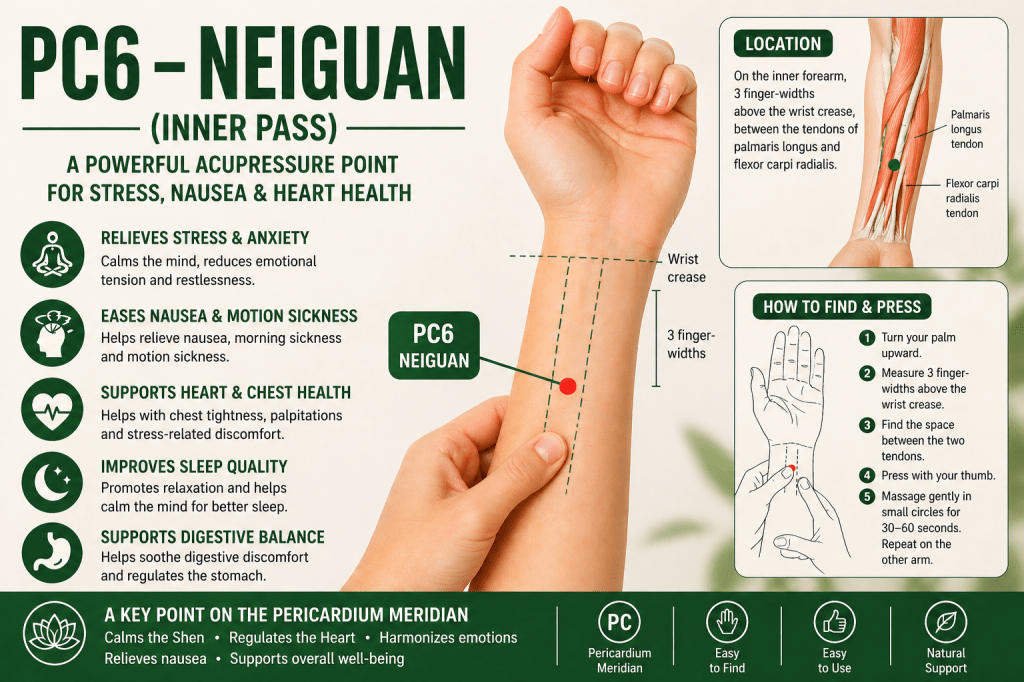
PC6 – Neiguan (Inner Pass)
A powerful acupressure point for stress, anxiety, nausea, and heart health
PC6 (Neiguan) is one of the most frequently used points in Traditional Chinese Medicine (TCM). It belongs to the Pericardium meridian and is widely known for its ability to calm the mind, regulate the heart, and relieve nausea.
This point is commonly used in acupuncture and acupressure for:
- stress and anxiety
- emotional imbalance
- nausea and motion sickness
- chest discomfort
- insomnia
Because of its strong effect on the Heart–Pericardium system, PC6 is often selected when emotional stress affects both the mind and body.
Location of PC6 (Neiguan)
PC6 is located on the inner forearm, about three finger-widths above the wrist crease.
How to find it:
- Turn your palm facing upward.
- Measure about three finger-widths above the wrist crease.
- Locate the space between the two tendons in the center of the forearm.
- The point sits between the tendons of palmaris longus and flexor carpi radialis.
When pressed, the area may feel slightly tender or sensitive, which helps confirm the correct location.
Meaning of the Name “Neiguan”
In Chinese:
内关 (Nèi Guān)
- 内 (Nèi) – inner
- 关 (Guān) – gate or pass
The name “Inner Pass” refers to the point’s function as a gateway that regulates the internal organs, particularly the Heart and chest region.
In TCM theory, PC6 acts as a key passage that influences emotional and physical balance.
Meridian Association
PC6 belongs to the Pericardium Meridian (Hand Jueyin Pericardium Channel).
This meridian travels from the chest through the arm to the hand and is closely related to the functions of the:
- Heart
- emotions
- circulation
- mental calmness
Because the Pericardium protects the Heart, points on this channel are often used to calm emotional disturbances and regulate the mind.
Main Benefits of PC6
Stress and Anxiety Relief
PC6 is one of the most commonly used points for calming the mind.
It may help with:
- anxiety
- emotional tension
- restlessness
- stress-related chest tightness
PC6 is included among the most effective acupressure points for stress and anxiety, as described in our article:
Practitioners frequently combine PC6 with points like Yintang and HT7 for deeper emotional relaxation.
Nausea and Motion Sickness
One of the best-known uses of PC6 is for nausea relief.
Modern research and clinical practice often use this point for:
- motion sickness
- morning sickness
- postoperative nausea
- digestive discomfort
Because of this effect, PC6 is sometimes called the “anti-nausea point.”
Heart and Chest Support
In TCM, PC6 strongly influences the Heart and chest area.
It may be used to support:
- chest tightness
- palpitations
- emotional stress affecting the heart
- mild circulation discomfort
By calming the Shen (mind), PC6 helps restore emotional balance.
Sleep and Mental Calm
Because PC6 relaxes the nervous system, it may also support:
- insomnia
- restless sleep
- mental agitation
- overthinking
Stimulating PC6 before bedtime can help the body transition into a more relaxed state.
How to Stimulate PC6 (Acupressure)
You can stimulate PC6 easily with acupressure.
Step-by-step technique
- Locate the point three finger-widths above the wrist crease.
- Place your thumb on the point.
- Apply firm but comfortable pressure.
- Massage gently in circular movements.
- Continue for 30–60 seconds.
- Repeat on the opposite arm.
A dull aching sensation is normal and indicates activation of the point.
Common Acupressure Combinations
PC6 is often combined with other points to enhance its therapeutic effects.
PC6 + Yintang
This combination is commonly used to calm the mind and reduce emotional tension. It is helpful for:
- anxiety
- mental restlessness
- difficulty relaxing
- sleep problems
Detailed location and information about Yintang EX-HN3 point
PC6 + HT7
Used to calm the Heart and Shen, this combination may help with:
- insomnia
- emotional imbalance
- stress-related palpitations
PC6 + ST36
This combination is often used to support digestion and energy balance. It may help with:
- nausea
- digestive discomfort
- fatigue
PC6 + LI4 (Hegu)
PC6 and LI4 are sometimes used together to regulate Qi circulation and relieve tension throughout the body. This combination may support:
- stress relief
- headaches
- emotional tension
Detailed location and information about Hegu LI4 point
When to Use PC6
PC6 is a good point to stimulate when you experience:
- anxiety or emotional stress
- nausea or motion sickness
- chest tightness related to stress
- difficulty sleeping
- restlessness or agitation
Because of its wide range of uses, PC6 is considered one of the most versatile acupressure points in TCM.
Safety Considerations
PC6 is generally safe for acupressure.
However:
- avoid excessive pressure
- stop if you feel sharp pain or numbness
- consult a healthcare professional for persistent symptoms such as chest pain or severe nausea
Acupressure should be viewed as supportive therapy, not a replacement for professional medical care.
Why PC6 Is One of the Most Important Acupuncture Points
Among the many points on the Pericardium meridian, PC6 is one of the most influential because it:
- calms the Shen (mind)
- regulates the Heart and chest
- reduces nausea and digestive discomfort
- supports emotional balance
For these reasons, PC6 is one of the most widely used points in both acupuncture and acupressure therapy.
Key Takeaways
- PC6 (Neiguan) is located on the inner forearm, three finger-widths above the wrist crease.
- It belongs to the Pericardium meridian.
- It is widely used for stress, anxiety, nausea, chest discomfort, and insomnia.
- The point is easy to stimulate using simple acupressure techniques.
- PC6 is considered one of the most versatile acupressure points in Traditional Chinese Medicine.
 Welcome to Acupressure Guide!
Leave a comment