
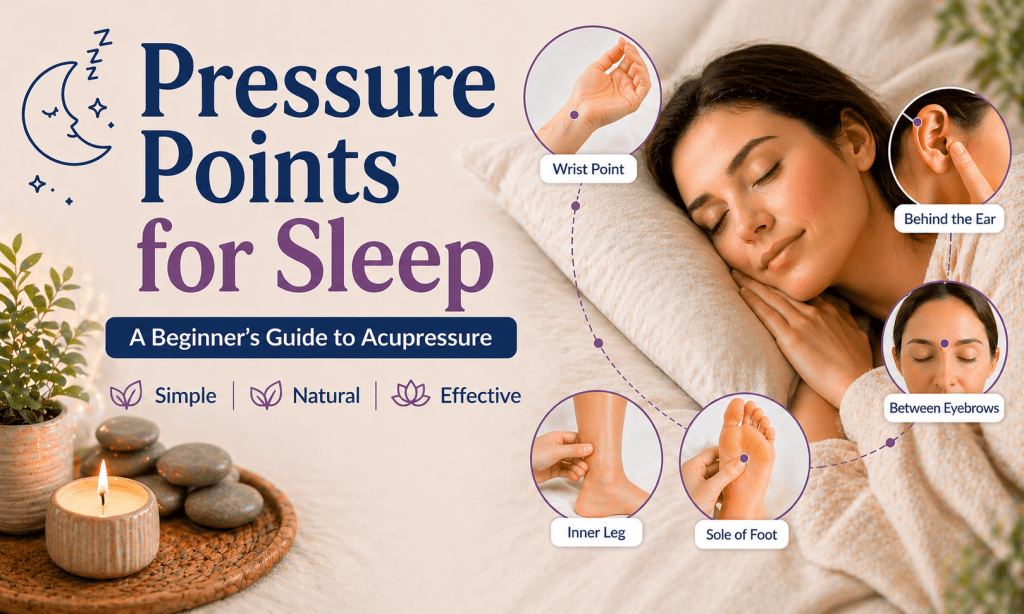
Pressure Points for Sleep: A Beginner’s Guide to Acupressure
Many people struggle with falling asleep, waking up during the night, or feeling mentally restless before bed. Stress, overthinking, long screen time, irregular routines, and emotional tension can all make sleep more difficult.
In Traditional Chinese Medicine, good sleep is connected with balance, calmness, and the smooth flow of Qi. When the mind is too active or the body feels tense, sleep may become lighter and less restful.
Acupressure is a gentle self-care method that uses finger pressure on specific points of the body. In this beginner-friendly guide, we will explore several useful pressure points for sleep that you can try before bedtime.
How Acupressure May Support Better Sleep
In Traditional Chinese Medicine, sleep is closely connected with the Heart, Liver, Spleen, Kidneys, and the overall balance of Yin and Yang.
When the body is too tense, the mind too active, or the nervous system overstimulated, it may be harder to relax into sleep.
Acupressure may help by:
- calming the mind,
- relaxing muscle tension,
- supporting emotional balance,
- helping the body shift into a more restful state,
- creating a calming bedtime ritual.
It is not a magic solution, but it can be a simple and natural tool to include in your evening routine.
1. HT7 – Shenmen: Spirit Gate
HT7, also known as Shenmen or “Spirit Gate,” is one of the most well-known acupressure points for calming the mind.
Location
HT7 is located on the wrist crease, on the little finger side of the wrist.
To find it, look at the inner side of your wrist. Move toward the side below your little finger. The point is located in a small hollow near the wrist crease.
How to use it
- Use the thumb of your opposite hand.
- Apply gentle but steady pressure to the point.
- Hold for 1–2 minutes.
- Breathe slowly and relax your shoulders.
- Repeat on the other wrist.
HT7 may be especially helpful when sleep problems are connected with anxiety, emotional tension, restlessness, or an overactive mind.
2. Anmian – Peaceful Sleep Point
Anmian means “peaceful sleep.” This point is commonly used in acupressure and acupuncture for sleep support and relaxation.
Location
Anmian is located behind the ear, between the earlobe and the base of the skull.
To find it, place your finger behind the ear and move slightly backward toward the area where the neck meets the skull. You may feel a soft, tender area.
How to use it
- Place your fingertips behind both ears.
- Apply gentle circular pressure.
- Massage for 1–2 minutes.
- Keep your breathing slow and relaxed.
Anmian may be useful when you feel tired but cannot fully relax, or when your body is ready for sleep but your mind remains active.
3. Yintang – The Third Eye Point
Yintang is located between the eyebrows and is often used for calming the mind and relaxing facial tension.
Location
Yintang is located in the center of the forehead, exactly between the eyebrows.
Detailed location and information can be found here:
How to use it
- Use your index or middle finger.
- Apply light pressure to the point.
- Hold for about 1 minute.
- Relax the forehead, eyes, and jaw.
This point may be helpful before sleep when you feel mentally tense, stressed, or unable to stop thinking.
4. PC6 – Neiguan: Inner Pass
PC6, also known as Neiguan or “Inner Pass,” is often used for calming the chest, easing emotional tension, and supporting relaxation.
Location
PC6 is located on the inner forearm, about three finger-widths above the wrist crease, between the two tendons.
Detailed location and information can be found here:
How to use it
- Place three fingers across your wrist to measure the distance.
- Find the point between the two tendons.
- Press gently with your thumb.
- Hold for 1–2 minutes.
- Repeat on the other arm.
PC6 may be useful if sleeplessness is connected with stress, emotional discomfort, tightness in the chest, or nervous tension.
5. SP6 – Sanyinjiao: Three Yin Intersection
SP6, also called Sanyinjiao, is an important point in Traditional Chinese Medicine. It is often used for relaxation, grounding, and supporting Yin energy.
Location
SP6 is located on the inner leg, about four finger-widths above the inner ankle bone, just behind the shin bone.
How to use it
- Sit comfortably and place one foot on the opposite knee.
- Find the inner ankle bone.
- Measure about four finger-widths upward.
- Press gently behind the shin bone.
- Hold for 1–2 minutes, then switch sides.
SP6 may be helpful when the body feels restless, tense, or ungrounded before sleep.
Important: SP6 is traditionally avoided during pregnancy unless guided by a qualified practitioner.
6. KD1 – Yongquan: Bubbling Spring
KD1, also known as Yongquan or “Bubbling Spring,” is located on the sole of the foot. In TCM, it is often used for grounding and calming excess activity in the head.
Location
KD1 is located on the bottom of the foot, in the depression that appears when you curl your toes downward.
It is roughly in the upper third of the sole.
How to use it
- Sit comfortably before bed.
- Use your thumb to press the point on the sole of the foot.
- Massage slowly for 1–2 minutes.
- Repeat on the other foot.
KD1 may be especially useful when your mind feels too active, your head feels “full,” or you need to feel more grounded before sleep.
Simple Acupressure Routine for Better Sleep
If you are new to acupressure, you do not need to use every point. A short and consistent bedtime routine is often better than doing too much.
Try this simple sequence:
- Start with Yintang for 1 minute to calm the mind.
- Massage Anmian behind the ears for 1–2 minutes.
- Press HT7 on both wrists for 1–2 minutes each.
- Use PC6 if stress or emotional tension is present.
- Finish with KD1 on both feet to feel grounded.
This routine can be done while sitting on the bed or lying down. Try to keep the room quiet, dim the lights, and breathe slowly.
Tips for Better Results
Acupressure works best when combined with healthy sleep habits. To support better sleep, try to:
- avoid bright screens before bed,
- keep a regular sleep schedule,
- reduce caffeine in the afternoon and evening,
- create a calm bedtime routine,
- keep the bedroom cool and dark,
- practice slow breathing while pressing the points.
Remember that acupressure is not only about the points themselves. It is also about slowing down and giving your body a signal that the day is ending.
When to Seek Medical Help
Occasional sleep problems are common, especially during stressful periods. However, frequent or long-term insomnia may need professional support.
You should consider speaking with a healthcare professional if:
- you cannot sleep well for several weeks,
- you wake up exhausted despite enough time in bed,
- sleep problems affect your work or daily life,
- you experience anxiety, depression, or panic symptoms,
- you snore heavily or wake up gasping for air,
- you rely on alcohol or medication to fall asleep.
Acupressure can support relaxation, but it should not replace medical care when sleep problems are persistent or severe.
Final Thoughts
Sleep is one of the foundations of health. When the body and mind are calm, it becomes easier to rest, recover, and wake up with more energy.
In Traditional Chinese Medicine, pressure points such as HT7, Anmian, Yintang, PC6, SP6, and KD1 are often used to support relaxation and better sleep.
Even a few minutes of gentle pressure before bed can become a calming evening ritual.
Start slowly, breathe deeply, and notice how your body responds. With regular practice, acupressure may become a simple and natural part of your sleep routine.
 Welcome to Acupressure Guide!
Leave a comment