
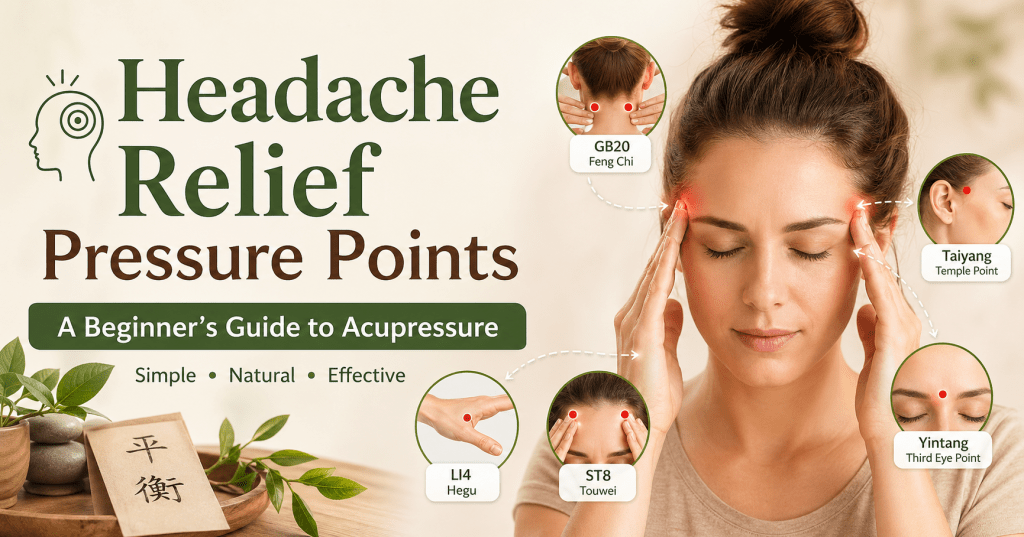
Headache Relief Pressure Points: A Beginner’s Guide to Acupressure
Headaches are one of the most common problems many people experience in daily life. Stress, long hours in front of a computer, poor sleep, dehydration, or tension in the neck and shoulders can all contribute to head pain.
In Traditional Chinese Medicine, acupressure has been used for centuries as a simple and natural way to support the body. By applying gentle pressure to specific points, we may help relax tension, improve circulation, and support the smooth flow of Qi.
In this beginner-friendly guide, we will explore several useful headache relief pressure points that you can try at home.
How Acupressure May Help with Headaches
In Traditional Chinese Medicine, pain is often understood as a sign that Qi and Blood are not flowing smoothly. When there is blockage, tension, or imbalance, discomfort may appear in different parts of the body — including the head.
Headaches may be connected with different patterns, such as stress, tension in the neck, emotional strain, fatigue, or external factors like wind and weather changes.
Acupressure works by stimulating selected points along the meridians. This may help the body relax, release tension, and restore a better sense of balance.
Some possible benefits of acupressure for headaches include:
- relieving muscle tension,
- supporting relaxation,
- calming the nervous system,
- improving local circulation,
- reducing stress-related discomfort.
1. LI4 – Hegu: Union Valley
LI4, also known as Hegu or “Union Valley,” is one of the most famous acupressure points for headaches. It is commonly used for pain in the head, face, jaw, and neck area.
Location
LI4 is located on the hand, in the soft webbing between the thumb and index finger.
To find it, bring your thumb and index finger together. A small muscle bulge will appear. The point is located near the highest part of that bulge.
Detailed location and more information can be found here:
How to use it
- Use the thumb of your opposite hand.
- Apply firm but comfortable pressure to LI4.
- Hold for 30–60 seconds.
- Breathe slowly and deeply.
- Repeat on the other hand.
This point may be especially useful for tension headaches, facial tension, stress-related headaches, and general head discomfort.
Important: LI4 is traditionally avoided during pregnancy. If you are pregnant, do not use this point unless advised by a qualified professional.
2. GB20 – Feng Chi: Wind Pool
GB20, known as Feng Chi or “Wind Pool,” is another important point often used for headaches, neck tension, and stiffness.
Location
GB20 is located at the base of the skull, in the hollows between the two large neck muscles.
To find it, place your thumbs at the back of your neck and slide them upward until they reach the place where the neck meets the skull. You should feel two small depressions on both sides.
How to use it
- Place both thumbs on the points.
- Apply steady pressure upward toward the base of the skull.
- Hold for 1–2 minutes.
- Breathe slowly and allow the neck to relax.
GB20 may be especially helpful when a headache is connected with neck tension, long computer work, stress, or stiffness in the upper back.
3. Taiyang – The Temple Point
Taiyang is an extra point located in the temple area. It is often used for headaches, migraines, eye strain, and tension around the forehead and temples.
Location
Taiyang is located in the small depression at the temple, slightly behind the outer corner of the eye.
If you gently clench your teeth, you may feel the muscle move in this area. The point is located close to that temple depression.
How to use it
- Place your index or middle fingers on both temples.
- Apply gentle pressure.
- Massage in slow circular movements.
- Continue for 1–2 minutes.
This point is often useful for headaches caused by screen fatigue, eye strain, stress, or tension in the side of the head.
4. Yintang – The Third Eye Point
Yintang is located between the eyebrows and is often called the “third eye” point. It is known for its calming effect.
Location
Yintang is located in the center of the forehead, exactly between the eyebrows.
Detailed location and more information can be found here:
How to use it
- Use your index finger or middle finger.
- Apply gentle pressure to the point.
- Hold for about 1 minute.
- Relax your face and breathe slowly.
Yintang may be helpful when headaches are related to stress, emotional tension, sinus pressure, or difficulty relaxing.
5. ST8 – Touwei: Head Corner
ST8, also called Touwei, is a point located near the hairline. It is commonly used in TCM for headaches affecting the forehead and temples.
Location
ST8 is located at the corner of the forehead, slightly above the hairline, on both sides of the head.
How to use it
- Place your fingertips near the front corners of the hairline.
- Apply gentle circular massage.
- Continue for 1 minute.
- Keep your breathing slow and relaxed.
This point may be useful for frontal headaches, tension around the forehead, and discomfort linked with mental strain.
Simple Acupressure Routine for Headache Relief
If you are new to acupressure, you do not need to use all points at once. A simple routine may be enough.
Try this beginner-friendly sequence:
- Start with Yintang for 1 minute to calm the mind.
- Massage Taiyang for 1–2 minutes to relax the temples.
- Press GB20 for 1–2 minutes to release neck tension.
- Finish with LI4 on both hands for 30–60 seconds each.
This routine can be done while sitting comfortably. Try to keep your shoulders relaxed and breathe slowly through the nose.
Tips for Better Results
To make acupressure more effective and comfortable, remember these simple tips:
- Use firm but comfortable pressure.
- Do not press so hard that it causes sharp pain.
- Relax your shoulders and jaw.
- Breathe slowly and deeply.
- Drink water after the session.
- Practice regularly if your headaches are stress-related.
Acupressure is not only about pressing points. It is also a moment to slow down, reconnect with your body, and release accumulated tension.
When to Seek Medical Help
Acupressure can be a helpful self-care method, but it is not a replacement for professional medical care.
You should contact a healthcare professional if your headache:
- appears suddenly and feels very severe,
- is different from your usual headaches,
- comes with fever, confusion, weakness, or vision problems,
- happens very frequently,
- gets worse over time,
- appears after an injury.
If you have a chronic condition, are pregnant, or take medication, it is best to consult a qualified practitioner before using acupressure regularly.
Final Thoughts
Headaches are often a signal that the body needs rest, relaxation, hydration, or better balance. In Traditional Chinese Medicine, acupressure offers a gentle way to support the body by stimulating specific points connected with the head, neck, and nervous system.
Points such as LI4, GB20, Taiyang, Yintang, and ST8 are simple enough for beginners and can be practiced at home.
Even a few minutes of mindful pressure and slow breathing may help reduce tension and bring a sense of relief.
As with all natural methods, consistency matters. Acupressure works best when combined with good sleep, hydration, stress management, and healthy daily habits.


Leave a comment